
What Spray Foam Insulation Involves
Spray foam is applied as a liquid that expands on contact and cures into a solid layer filling the assembly. Because it expands rather than being cut to fit, it seals around framing, wiring, and pipes where conventional materials leave gaps.
The choice between types comes down to what the assembly needs. Closed cell provides more R-value per inch and is generally used where depth is restricted, while open cell is lighter and expands further.
Who Is This Service For?
Spray foam suits Downey properties where depth or sealing is the limiting factor.
- Home additions built to current requirements — Modern R-values applied to existing framing create depth conflicts.
- Garage conversions and ADUs — Converted structures rarely offer the depth a conversion specification assumes.
- Homes with vaulted or sloped ceilings — These assemblies cannot take a conventional insulation thickness.
- Properties with drafts that insulation has not fixed — Sealing addresses air movement directly.
- Renovations exposing the roof structure — Access during works is the practical moment for foam.
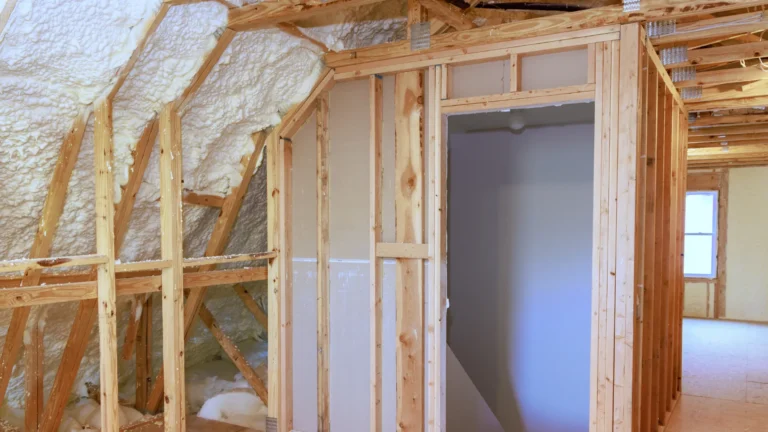
What Spray Foam Insulation Covers for Downey Properties
The first question the assessment answers is whether foam is genuinely needed, because in a standard accessible attic it usually is not. Where blown-in insulation can reach the target depth, that is the recommendation and it costs considerably less.
Where the assembly restricts depth, the specification then covers foam type, applied thickness, and the areas being treated.
What the Assessment Covers
The assessment establishes suitability before pricing is discussed.
- Required R-value against available depth — The calculation that determines whether closed cell is necessary.
- Assembly construction — Rafter, joist, and stud depth are checked directly rather than assumed.
- Existing material condition — Old insulation generally needs clearing, since foam bonds to the substrate.
- Preparation requirements — Areas needing masking and protection are identified upfront.
- Conventional alternatives — Blown-in and batt options are priced wherever the depth permits them.
What the Installation Includes
Work follows a consistent sequence once scope is agreed.
- Removal of existing insulation — Old material is cleared so foam bonds properly to the surface.
- Masking and protection — Adjacent surfaces and access routes are covered before spraying begins.
- Application to specified thickness — Foam is applied to the depth the assembly and target require.
- Consistent depth across the surface — Thickness is checked as work progresses rather than after curing.
- Cure time explained — Timing before reoccupation or the next trade is confirmed on site.
- Cleanup — Masking, waste, and equipment are removed and the area cleared before the crew leaves.
How Spray Foam May Benefit Your Downey Property
In a restricted assembly, closed cell foam may reach a required R-value that no conventional material could achieve in the same depth. On an addition or conversion, that can be the difference between passing inspection and reworking the assembly.
Sealing is the second benefit, since foam closes the air pathways that remain open regardless of how much conventional insulation is fitted.
What Downey Property Owners Report
These are the outcomes that come up most often after foam work.
- Required R-values achieved in tight assemblies — Foam may reach targets batts physically cannot.
- Sealed additions that hold temperature — Newly built spaces may perform more consistently than expected.
- Reduced drafts — Sealing the assembly addresses air movement conventional insulation leaves alone.
- Coverage around services — Foam fills around wiring and pipes rather than being cut around them.
- Inspection readiness — Depth and coverage are what an inspector verifies before drywall.
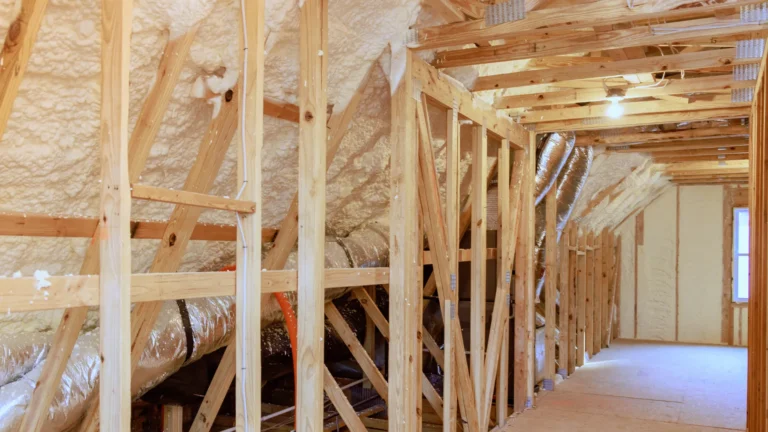
Spray Foam Insulation at Torres Insulation Inc.
Downey sits close to the Whittier base, which makes assessment visits and follow up straightforward. On foam work that proximity is useful, since these projects usually sit on a construction programme where timing is tight.
Application quality is judged on consistency, because foam cannot be corrected once cured and inspectors check thickness directly. Depth is verified across the assembly as work progresses.
Where a conventional system can meet the requirement within the depth available, that is what gets recommended. Foam is priced against the alternatives rather than presented as the automatic upgrade.
Common Questions About Spray Foam Insulation in Downey
How much does spray foam insulation cost in Downey?
Cost depends on the area covered, foam type, thickness required, and access to the assembly. Closed cell generally costs more per square foot than open cell because of its density. Estimates are free and blown-in alternatives are priced alongside where the depth allows.
Do I need spray foam for a Downey home addition?
It depends on the R-value your plans require and the depth your framing offers. Additions built to current requirements on existing structures frequently run into that conflict. The calculation is made against your specific drawings and assembly.
Is spray foam worth it for a standard Downey attic?
Usually not, since accessible attics with adequate depth are well served by blown-in insulation at considerably lower cost. Foam earns its place where depth is restricted or sealing is the specific problem. The assessment gives you the honest answer either way.
How close is your team to Downey for spray foam work?
The company is based in nearby Whittier, which makes Downey one of the closer markets served. Short travel distance generally means easier scheduling, which matters on projects with tight programme dates. Local assessment visits are simple to arrange.
When should spray foam go in during a Downey conversion?
Foam is installed after framing, electrical, and plumbing rough-ins are complete and before drywall closes the assembly. It is usually inspected at that point. Scheduling is coordinated with the other trades so the sequence holds.
Find Out Whether Spray Foam Suits
Your Downey Project
If an addition or conversion has to hit an R-value the framing will not accommodate, foam may be the answer. Send the details and the assessment and estimate cost nothing.